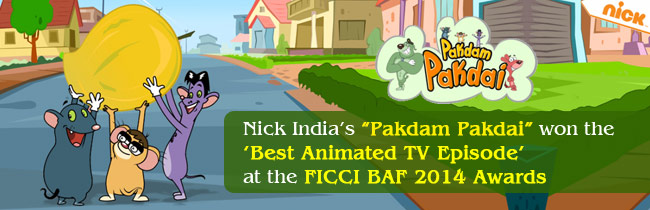
Nick India’s “Pakdam Pakdai†won the ‘Best Animated TV Episode’
Nick channel continues to keep its promise of offering exceptional entertainment for Nicksters with establishes of its\' third homegrown show, Pakdam Pakdai after the successful launch of \'Motu Patlu\' and \'Keymon Ache\'.
March 25th, 2014
Nick channel continues to keep its promise of offering exceptional entertainment for Nicksters with establishes of its' third homegrown show, Pakdam Pakdai after the successful launch of 'Motu Patlu' and 'Keymon Ache'. Kids can enjoy the Bollywood flavored dialogues and the crazy characters from the show from Monday to Friday at 6:30 PM on Nick.
Toonz animation and Nick have come together to give children Pakdam Pakdai - A chase comedy, that is a rollicking adventure between a friendly, but gullible dog Doggy Don, and the three naughty mice that live in his house Chotu, Lambu and Motu. Doggy Don is helped in his futile, but fun efforts to defeat the mice by his older brother Colonel, an ex-army dog who is smarter than Doggy Don, but not as smart as the three mice.
The utterly butterly Amul Girl, who has stayed on billboards for years, will soon appear in an animated avatar. The project, which will mark the golden jubilee of the Amul girl ad, will be as exciting as the printed ones, ensure its architects.
At MIFF2014 Gitanjali Rao’s “True Love Storyâ€& Dhavani Desai’s Chakravyuh got awards
The seven day international documentary film festival, MIFF 2014 concluded in Mumbai with the best of the work in documentary, animation and short films honored with awards, presented by film makers Adoor Gopalakrishnan and Shyam Benegal.
Phenakistoscope (1831) A phenakistoscope disc by Eadweard Muybridge (1893).The phenakistoscope was an early animation device. It was invented in 1831 simultaneously by the Belgian Joseph Plateau and the Austrian Simon von Stampfer. It consists of a disk with a series of images, drawn on radii evenly spaced around the center of the disk. Slots are cut out of the disk on the same radii as the drawings, but at a different distance from the center. The device would be placed in front of a mirror and spun. As the phenakistoscope is spun, a viewer would look through the slots at the reflection of the drawings which would only become visible when a slot passes by the viewer's eye. This created the illusion of animation.